
Academic Rigor Meets the Cosmos: The Strategic Synergy Behind the 33rd Science Congress
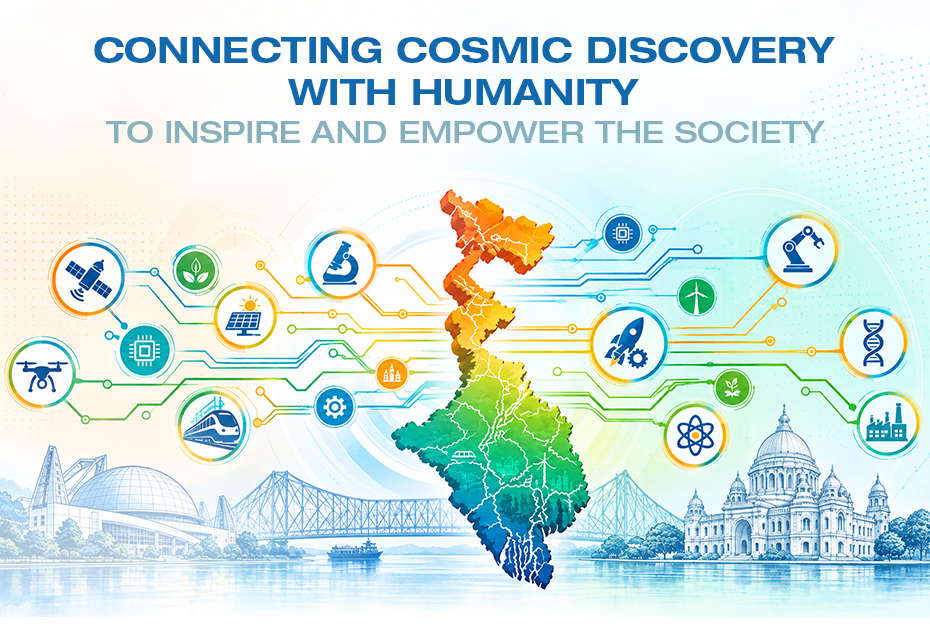
The recently concluded 33rd West Bengal Science and Technology Congress 2026 in Kolkata marked a definitive shift in how people approach institutional innovation and how it has revolutionized the paradigm. With over 3000 delegates, researchers and scientists attended the conference. The event transformed and evolved beyond the conventional research forum to anchor a new paradigm, design the infrastructure and build a roadmap for high-impact, collaborative science. Driving this evolution was a dual-centric approach: Making space-tech accessible and expanding advanced scientific and academic infrastructure.
As highlighted by the West Bengal minister for science and technology, Kalyan Chakraborty, the aim is to bridge departmental divides, establish a symbiotic, operational matrix, pave a path for a strategic research master plan and also with a view to future joint ventures and collaborations. He laid foundation stones for two major state projects during the event. The state projects include Astro Park in the Nadia district and a satellite Biotech Hub in the town of Kalimpong. The Astro Park project will be built in association with the National Council of Science Museums. Real scientific advancement unfolds when premium, advanced and exemplary academic research and deep, cutting edge space innovation converge to inspire the next generation and to build public infrastructure.
Here is how the Science Congress will be bridging the gap between research facilities, the cosmos and the masses.
High-Tech Academic Commercialization with IIT-Kharagpur
Bridging the theory-practice gap, a landmark Memorandum of Understanding (MoU) with IIT-Kahragpur deploys and operationalizes high-level engineering into scalable, real-world systems. By aligning initiatives and driving ventures around public service and societal benefit, this partnership will catalyze the world-class laboratories of Indian Institute of Technology to resolve multifaceted foundational, operational and technical challenges.
Standardizing Space Exploration with ISRO
Space Technology is emerging from and diversifying beyond aerospace silos to mainstream markets. Strategic initiatives with Indian Space Research Organisation (ISRO) are designed to integrate space research directly into schools and higher education curriculum. This ensures that satellite technologies and astronomical data serve as the bedrock for future researchers, engineers and developers.
Precision Mapping with NATMO:
Aligning with the expansion of space technology and expanding the horizons of the aerospace technology drive, a collaboration with the National Atlas and Thematic Mapping Organization (NATMO) transmits satellite data to the earth’s ground station. This alliance will power the development of hyper-local high-resolution maps at the Panchayat level to support local autonomy, coupled with key accessibility technology like Braille maps for the visually impaired .
Localised Knowledge Transfers
To ensure scientific research is inclusive, the Science Congress published 215 research paper abstracts, covering 12 distinct scientific subjects in Bengali language together with English, breaking down linguistic barriers in STEM with the goal of promoting scientific literacy and communication in the local language.
The synergy between ISRO and IIT highlights a crucial macroeconomic trend, the future of innovation belongs to collaborative ecosystems and not solitary ventures. When space agencies offer their frontier data and elite institutions lend its processing power, it builds a hyper-resilient foundation for the bio-tech economy and broader technology.
For industry leaders, the mandate is clear: real market value is unlocked when high-level, advanced research is intentionally engineered to resolve scalable, real-world issues.