

The Light of Bengal: How Ishwar Chandra Vidyasagar Reshaped Modern India
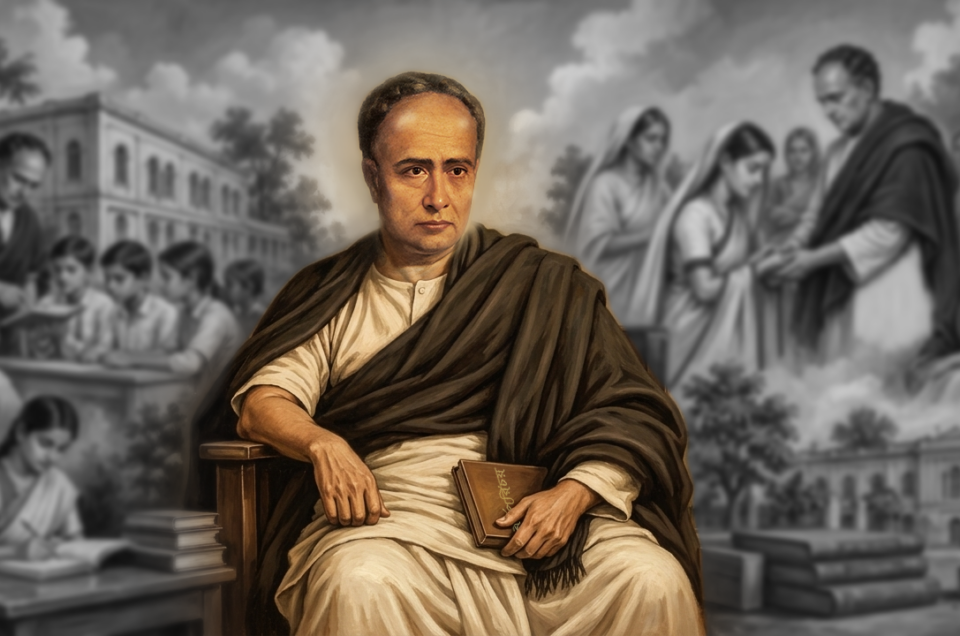
The era of the 19th century Bengal Awakening, also referred to as Bengal’s age of enlightenment, is a landmark period in the historical evolution of the Indian education system. It was during this time that the progressive thinking, open-mindedness and forward-looking mindset of the western countries set foot in Bengal. The surge and penetration of western culture, art and knowledge along with refined moral principles elevated, cultivated and enlightened the collective intellectual consciousness of the liberal thinkers of Bengal. Also, The European intellectual canon triggered a mindset shift and began taking root among the Indian population. Among several visionary intellectuals and intellectual luminaries of the Bengal Renaissance, one of the brilliant minds and key figures of the nineteenth century era was an Indian Educationist and Social Reformer Ishwar Chandra Bandyopadhyay, widely known as Ishwar Chandra Vidyasagar. He was the pillar, principal proponent and polymath of the Bengal Renaissance period and played a vital role in the modernization and academic reform of the Indian education system. He was the cultural luminary of Bengal who dedicated his entire life for the upliftment, reformation, renaissance and evolution of Bengali society.
During the 19th century Bengal, Ishwar Chandra Vidyasagar was the driving force in advancing progressive contemporary education as well as civic awakening. Apart from fostering intellectual growth and advocating for educational progress within the superstitious Hindu population in their vernacular, Ishwar Chandra Vidyasagar also committed himself within the domain of practical social reform such as pioneering and championing widow remarriage. At a time when, on one hand the British government turned their deaf ear to the Indian people, Indian heritage and Indian culture and intended to manage the educational landscape on their own terms. Conversely, the Indian natives adhered to several superstitious rituals and beliefs and were culturally detached and ignorant of their own heritage. In these circumstances, Ishwar Chandra Vidyasagar dedicated himself in revolutionizing and modernizing the education system and the society. He endeavoured to rupture the unconventional customs and practices and aimed to structure the society rooted in and around the pillars of cooperation, transparency and realism.
When discussing and tracing the brands woven into the fabric of Bengal, whether it is the cultural resonance of Senco Gold or the timeless trust of Boroline, what commonly draws attention and is regularly addressed is their market legacy, consumer trust and advertising campaigns.
But what if the blueprint for building an industry titan or an iconic powerhouse was written over 150 years ago by the ultimate reformer of Bengal? The Great Ishwar Chandra Vidyasagar.
Through the lens of modern business, Ishwar Chandra Vidyasagar was not simply a scholar; he was the ultimate conscious, social brand strategist. He confronted and battled the absolute dominance and undisputed giant, the rigid, societal norms of the nineteenth century Bengal and entirely fractured the status quo and fundamentally revolutionized women empowerment and liberation of women from unreasonable societal barriers.
As modern businesses address gender diversity, advocating for a cause, and Corporate Social Responsibility (CSR), the life of Ishwar Chandra Vidyasagar offers a masterclass in how to catalyze and foster credible, large-scale systematic reform.
The Fight for Dignity (Identifying the Core Problem): Every successful brand begins with resolving a vital and core issue first. In the era of Ishwar Chandra Vidyasagar, the most significant structural collapse was the horrific treatment and brutal exploitation of women, notably youthful widows. They were subjugated, condemned to perpetual abandonment and deprived of their core liberties and fundamental human rights. Ishwar Chandra Vidyasagar did not merely sympathize with the situation, he made it his brand purpose to handle and rectify it. He intensely campaigned against polygamy and child marriage. His relentless efforts led to the pivotal and historic enactment of social reform legislation Act XV of 1856 that legalized Hindu widow remarriage in the British possession territories.
An iconic, reputable brand does not simply put out a tagline; but it stays true to its principles. While walking the talk, Ishwar Chandra Vidyasagar encountered death threats and intense social boycott, yet he fixed the remarriage of his own son, Narayan Chandra, to a young widow.
Modern consumers instantly recognize the lack of consistency and conflict between the public messaging and operational reality of a brand. Ishwar Chandra Vidyasagar educates everyone that brand ethos and core identity of a brand demands taking a tangible risk. If a business claims to support the empowerment and equity of women, it should show up in the equal pay, company culture and internal hiring of the organization and not only on a Women’s Day banner.
Female Literacy as Infrastructure (Investing in the Future Consumer): A visionary leader keeps eyes on the horizon by being future focused and investing in building long-term infrastructure rather than being distracted by quick wins. Ishwar Chandra Vidyasagar realised that statutory approval or enacting a statute was only half the battle. To genuinely liberate women and secure their rights, education served as the supreme weapon for financial and social independence.
To break into and dominate a market, a business must invest in it. Legacy brand giants in Bengal are those established market leaders who place local community welfare at the core of their business framework. Brands can build a resilient infrastructure and an intensely committed customer tribe by supporting education of girls or upskilling local female artisans.
Simplification and Empathy (Communicating the Message): Prior to Ishwar Chandra Vidyasagar, religious and educational texts were written in complex Sanskrit, which was inaccessible to the average woman. Ishwar Chandra Vidyasagar realised that to empower women, it was crucial to make knowledge and education accessible. He restructured the Bengali alphabet and wrote Bornoporichoy which was released in two volumes in the year 1855. By simplifying the language, he ensured that the young girls who entered his schools could easily write, read and think independently.
While designing and marketing financial apps and tools centered on the unique and distinctive requirements of women, simplicity and accessibility triumphs and scales. Audience centric clarity and value driven message is the ultimate tool for developing a connection.
The Verdict: The Legacy of Ishwar Chandra Vidyasagar for Modern Brands
Ishwar Chandra Vidyasagar endures as a supreme visionary in the realm of Bengali language and literature, he is hailed as the Pioneer of Bengali Prose. His contributions and lifelong dedication redefine the horizons of formal learning and social justice. He shattered conservative traditions and actively challenged the status quo along with breaking cultural and linguistic barriers, leaving an everlasting imprint on the Indian literary and intellectual landscape. His insights and focused efforts constantly motivate and guide the vision of human kind about the transformative power of literature which functions as a catalyst for cultural enrichment, social progress, overall societal improvement and humanistic progress. The legacy of Ishwar Chandra Vidyasagar is permanently woven within the annals of the social and intellectual history of India. His solitary but unwavering dedication and commitment for the betterment of humanity and in the service of society endures as a powerful historical legacy, underscoring the critical impact of intellectual enlightenment and education as the core drivers of collective human evolution.
Ishwar Chandra Vidyasagar elevated the social fabric, Bengali language, and Bengali literature from its medieval shadows into the absolute vanguard of modern thought and progress. By recontextualizing historical practices and ancestral customs through the combined metrics of empathy, ethical responsibility and reason, he mapped out and pioneered a reform route and paved a way for change that was culturally recognized and ethically progressive and future-oriented. The life of Ishwar Chandra Vidyasagar constantly epitomizes the power of learning and information, the moral courage, and the civil liberties, secular ethics, human rights and Humanitarian values. His legacy endures as a lighthouse and also serves as an anchor as India steers through the complex dynamics of socioeconomic disparity, cultural heritage and educational reform in today’s modern era. Ishwar Chandra Vidyasagar taught the human kind that to build an enduring heritage and leave an indelible mark, one must first be a Crusader and then a Creator. And modern businesses must keep people over profit, fight for real equity and their brand value will endure indefinitely.